VX Sagittarii
VX Sagittarii Encyclopedic Information
Deep in the heart of the constellation Sagittarius lies VX Sagittarii, a celestial titan that makes our own Sun look like a mere grain of sand. Classified as a semi-regular variable red hypergiant, this star is an absolute behemoth of the cosmos, pushing the boundaries of stellar physics. It is a star living life in the fast lane, burning through its nuclear fuel at a furious rate as it marches toward its inevitable, explosive demise. Studying VX Sagittarii offers astronomers a front-row seat to the chaotic end-stages of massive stellar evolution, providing vital clues about how the universe recycles heavy elements back into the interstellar medium.
What makes VX Sagittarii truly fascinating is its sheer, mind-boggling scale. If you were to swap it with our Sun, its outer layers would stretch well beyond the orbit of Jupiter, swallowing the inner solar system whole. This is a star that defies simple categorization, pulsating with an erratic rhythm that keeps astrophysicists on their toes. It serves as a reminder of the sheer violence and majesty inherent in the lifecycle of stars, acting as a cosmic laboratory where gravity and radiation pressure engage in a perpetual, high-stakes tug-of-war.
History & Significance
Unlike the bright stars known to ancient civilizations, VX Sagittarii remained hidden from the naked eye for millennia, obscured by the dense clouds of interstellar dust within the Milky Way's galactic plane. It was only with the advent of modern infrared astronomy that this hidden giant was pulled from the shadows. While it lacks the rich mythological tapestry of stars like Sirius or Orion, its place in the modern catalog of 'monsters' has made it a focal point for 20th and 21st-century stellar research. Its discovery marked a turning point in our understanding of the 'Zone of Avoidance,' where dust hides the most interesting secrets of our galaxy.
Recent decades have seen VX Sagittarii become a primary target for high-resolution interferometry and long-term monitoring programs. Missions and observatories, including the Hubble Space Telescope and various ground-based VLT (Very Large Telescope) instruments, have scrutinized its complex atmosphere. These observations have allowed scientists to map the star's pulsation cycles and mass-loss rates, effectively turning this distant hypergiant into a benchmark for testing stellar evolution models. It is no longer just a dot on a map, but a dynamic, evolving entity that helps us calibrate the life cycles of the most massive stars in the galaxy.
Physical Structure
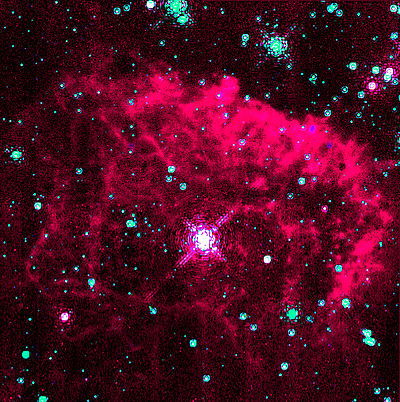
VX Sagittarii is a chaotic, layered masterpiece of stellar physics, characterized by a vast, extended atmosphere that is constantly being shed into space. Unlike the solid surfaces of planets, this star is a churning sphere of plasma where convective cells the size of entire planetary orbits roil and bubble. Its atmosphere is incredibly tenuous, effectively blending into the surrounding circumstellar envelope. This envelope is a swirling, dusty shroud composed of silicates and water vapor, created by the intense stellar winds that blast material away from the star at staggering speeds. This mass loss is the star's way of shedding its outer layers as it prepares for its final collapse.
Deep within this gaseous veil lies the core, a dense, pressurized engine currently fusing heavier elements in a desperate attempt to stave off gravitational collapse. The magnetic field surrounding the star is complex and turbulent, driven by the violent convection in its outer layers. Because the star is a semi-regular variable, its physical dimensions and temperature fluctuate significantly over time, causing it to shift color from a deep, smoldering orange to a brilliant, ruby red. It is a star in flux, a pulsating heart of the galaxy that is slowly dismantling itself, layer by layer, to eventually seed the cosmos with the building blocks of future solar systems.
✨ Cosmic Secrets & Fun Facts
- ✦ Observations of VX Sagittarii form a critical component of tracking our galactic structure.
- ✦ Stars are giant cosmic foundries, safely forging the heavy elements that make up planets and organic systems.
Related Celestial Bodies
Explore other significant celestial entities in the Sagittarius constellation and beyond.

Add StarryDex to your Home Screen
Tap Share, then Add to Home Screen. It opens full screen and works offline.