GJ 667 C c
GJ 667 C c Encyclopedic Information
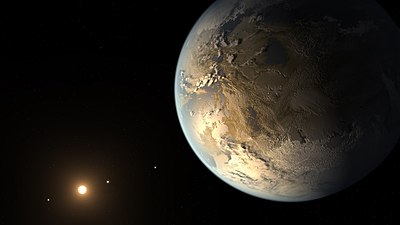
Imagine standing on a world where the horizon is bathed in the crimson glow of a nearby red dwarf, while two other distant suns dance like bright jewels in the sky. This is GJ 667 C c, a Super-Earth that has captured the imagination of astronomers and dreamers alike since its discovery. Located just 23.6 light-years away in the constellation Scorpius, this exoplanet sits snugly within the Goldilocks Zone of its host star, where temperatures are just right for liquid water to potentially pool on its surface. It isnt just another cold rock in the void; it is a beacon of hope in our search for life beyond the Solar System.
What makes GJ 667 C c truly remarkable is its membership in a complex triple-star system. While most planets we find orbit a single lonely star, this world exists in a cosmic ballet, influenced by the gravitational tug of three different suns. This unique celestial arrangement challenges our understanding of planetary formation and survival, proving that stable, potentially habitable environments can flourish in even the most crowded of stellar neighborhoods. It is a testament to the diversity of the universe and a profound reminder that Earth-like does not have to mean Earth-identical.
Scientifically, GJ 667 C c serves as a critical laboratory for studying the habitability of planets around M-dwarf stars. Because these stars are cooler and more volatile than our Sun, the conditions on this planet provide vital clues about whether life can endure the intense flares and tidal locking common in such systems. Philosophically, it forces us to reconsider our place in the cosmos. If a world with three suns can sustain the ingredients for life, the possibilities for biology across the galaxy are virtually limitless.
Related Celestial Bodies
Continue your cosmic journey by exploring other planetary bodies and astronomical wonders.


History & Significance
The story of GJ 667 C c began in the early 2010s, a golden era for exoplanet hunting. It was first announced in late 2011 and further detailed in 2012 by a team of astronomers using the High Accuracy Radial velocity Planet Searcher (HARPS) spectrograph on the ESO 3.6-metre telescope at the La Silla Observatory in Chile. By measuring the tiny wobbles in the stars motion caused by the planets gravity, researchers were able to confirm the existence of this rocky neighbor. Unlike the ancient planets of our solar system, GJ 667 C c carries no Greek or Roman myths, but it represents the modern mythology of the Silicon Age—the quest to find a second home among the stars.
While no physical mission has yet visited the Scorpius constellation to see this world up close, it has been the subject of intense virtual missions through the worlds most powerful observatories. Beyond the initial HARPS data, the planet was scrutinized using data from the Keck Observatory and the Magellan Telescopes. These observations helped refine its mass and orbital period, cementing its status as one of the most Earth-like candidates ever found in a multi-star system. It remains a primary target for future deep-space characterization missions, such as the James Webb Space Telescope (JWST), which may one day peer through its atmosphere to look for the chemical signatures of life.
Physical Structure
Physically, GJ 667 C c is a heavyweight. With a mass roughly 3.8 times that of Earth, it is classified as a Super-Earth, suggesting a rugged, rocky composition potentially rich in silicates and iron. Because it orbits so close to its parent star—completing a year in just 28 Earth days—it is likely tidally locked. This means one hemisphere is trapped in eternal, fiery daylight, while the other is shrouded in a permanent, frozen night. Between these two extremes lies a twilight zone or terminator line, where temperatures might be moderate enough to support a stable atmosphere and perhaps even liquid oceans.
The atmosphere of GJ 667 C c is a subject of great intrigue. If it possesses a thick enough gaseous envelope, it could distribute heat from the day side to the night side, preventing the atmosphere from collapsing into ice. The sky would appear vastly different from our own; the primary star, Gliese 667 C, would appear much larger and redder than our Sun, casting a deep ochre hue over the landscape. Meanwhile, the two distant companion stars, Gliese 667 A and B, would shine brightly enough to be visible during the day, appearing as a pair of brilliant points of light. The core of the planet is likely still geologically active, potentially generating a magnetic field that protects the surface from the stellar winds of its red dwarf host, a crucial ingredient for long-term habitability.
✨ Cosmic Secrets & Fun Facts
- ✦ Discovered in 2013 using the Radial Velocity method.
- ✦ Located approximately 7 light-years from Earth.
