KW Sagittarii
KW Sagittarii Encyclopedic Information
Deep within the bustling heart of our galaxy, hidden behind the dense dust clouds of the Sagittarius constellation, lies KW Sagittarii—a celestial titan that defies the imagination. As a red supergiant of staggering proportions, it stands as a testament to the violent, beautiful life cycles of massive stars. To gaze toward its location is to peer into a cosmic furnace, where the fundamental elements of life are forged in the crucible of extreme gravity and intense heat, serving as a reminder of the sheer scale of our universe and our own humble origins within the cosmic dust.
History & Significance
KW Sagittarii was formally cataloged during the mid-20th century as astronomers began mapping the variable stars of the Milky Way’s bulge. While it lacks the ancient mythological baggage of bright, naked-eye stars like Sirius or Betelgeuse, its discovery marked a turning point in our understanding of stellar evolution. By identifying such luminous beacons, scientists gained critical 'standard candles' to measure the vast, chaotic distances across our galaxy. Unlike the stars of antiquity, KW Sagittarii belongs to the modern era of infrared astronomy, where specialized telescopes have peeled back the veils of interstellar dust to reveal its true, brilliant nature.
While no space probe has visited this distant giant, it remains a primary target for ground-based observatories and space-based infrared platforms like the James Webb Space Telescope. By studying the light curves and spectral signatures of stars like KW Sagittarii, researchers are piecing together the chaotic history of the Milky Way’s formation. It acts as a silent witness to the galactic migration and gravitational interactions that have shaped our neighborhood over billions of years, providing a vital link in the long chain of cosmic chronology.
Physical Structure
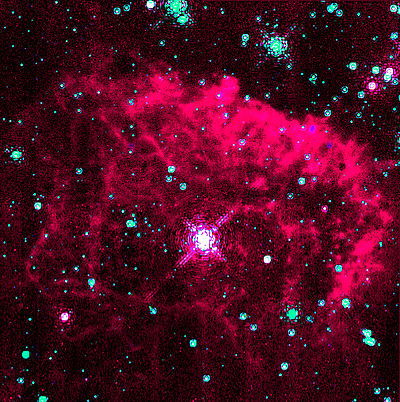
Imagine a sphere so vast that if it were placed at the center of our solar system, its outer reaches would swallow the orbit of Mars and potentially even Jupiter. KW Sagittarii is a pulsating red supergiant, a star in the twilight of its existence, characterized by a bloated, diffuse atmosphere that extends millions of kilometers into space. Its surface temperature is relatively cool, giving it that signature crimson glow, but its luminosity is truly blinding—emitting thousands of times more energy than our Sun. This star is literally shedding its outer layers in a frantic, final performance, casting off shells of gas and dust into the interstellar medium.
Beneath its turbulent, convective photosphere, the core of KW Sagittarii is a high-pressure pressure cooker where nuclear fusion has shifted from hydrogen to heavier elements. It is currently in a complex phase of burning helium, frantically trying to stave off the inevitable gravitational collapse that will eventually culminate in a spectacular supernova. The magnetic fields surrounding this giant are complex and unpredictable, driving massive stellar winds that sculpt the surrounding nebular environment. It is a fragile, unstable structure—a gargantuan bubble of gas held together by a razor-thin balance between the crushing inward pull of gravity and the explosive outward pressure of its dying heart.
✨ Cosmic Secrets & Fun Facts
- ✦ Observations of KW Sagittarii form a critical component of tracking our galactic structure.
- ✦ A star's color is a direct mathematical indicator of its surface temperature—blue stars are significantly hotter than red stars.
Related Celestial Bodies
Explore other significant celestial entities in the Sagittarius constellation and beyond.

Add StarryDex to your Home Screen
Tap Share, then Add to Home Screen. It opens full screen and works offline.