Kepler-62 e
Kepler-62 e Encyclopedic Information
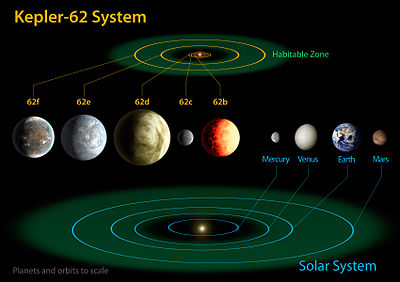
Kepler-62 e is a tantalizing world that sits right in the sweet spot of cosmic exploration: the habitable zone. Located roughly 1,200 light-years away in the constellation Lyra, this distant neighbor is a Super-Earth or Mini-Neptune that has captured the imagination of astronomers worldwide. Because it orbits its host star at a distance where liquid water could theoretically persist on its surface, it represents one of our best candidates in the ongoing search for life beyond our solar system. It is a world of immense philosophical weight, forcing us to ask: if a planet like this exists, are we truly alone in the vast, silent expanse of the Milky Way?
Related Celestial Bodies
Continue your cosmic journey by exploring other planetary bodies and astronomical wonders.


History & Significance
The discovery of Kepler-62 e was announced in 2013, marking a milestone for NASA’s Kepler Space Telescope. By using the transit method—detecting the slight dip in brightness as the planet crossed in front of its star—astronomers were able to confirm its existence alongside its sibling, Kepler-62 f. Unlike the ancient planets named after Roman or Greek deities, this world bears the designation of the mission that found it, representing a new era of catalog-based cosmic exploration. Its discovery was a testament to the precision of modern photometry, proving that we could detect rocky worlds orbiting distant suns with incredible accuracy.
While it doesnt have a mythological namesake, Kepler-62 e has become a legend in its own right within the astrobiology community. It serves as a flagship case study for the Habitable Exoplanets Catalog. The mission that unveiled it fundamentally changed our understanding of planetary systems, shifting our focus from giant gas balls to smaller, potentially rocky worlds that mirror the conditions of our own home. It stands as a beacon for future missions like the James Webb Space Telescope to potentially probe for biosignatures in its atmosphere.
Physical Structure
Kepler-62 e is roughly 1.6 times the size of Earth, placing it firmly in the category of planets that are larger than our own but smaller than the ice giants. Its massive radius suggests it could be a water world, potentially covered entirely by a global, deep ocean, or perhaps a world with a thick, humid atmosphere. The gravity on its surface would be significantly stronger than what we experience on Earth, which would likely result in a very different geological landscape—perhaps flatter, with vast, shallow seas dominated by high-pressure environments that we are only beginning to model mathematically.
Beneath its potential watery shroud, scientists speculate that Kepler-62 e likely possesses a dense, rocky core composed of iron and silicate minerals. Because it orbits a star slightly smaller and cooler than our Sun, the planet experiences a unique radiative environment. If it possesses a strong magnetic field, it might be shielded from the stellar winds of its host star, preserving a stable climate. However, the true nature of its atmosphere remains the holy grail of the system; it could range from a dense, greenhouse-gas-rich blanket that traps heat, to a thin, airy shroud that barely holds onto its surface water. It is a world of extremes, waiting for the next generation of telescopes to strip away its mysteries.
✨ Cosmic Secrets & Fun Facts
- ✦ Discovered in 2013 using the Transit method.
- ✦ Located approximately 301 light-years from Earth.
